

Content Bridges
Berkshire Hathaway Media Group: Financial Engineering Makes the Deal
May 17, 2012
It’s the early movements of the ball that make this deal more a feat of financial engineering than a newspaper deal:
Lend Media General $400 million, and extend a $45 line of credit, at 10.5% interest. That allows Media General to escape shorter-term financial pressures, and gives BH a good profit along the way.
Gain warrants that are convertible to about 19.9 percent of Media General’s outstanding shares. The new Media General is mainly a broadcast company, a sector with its share of issues, but with lots more projectable upside than the newspaper industry. So it’s gotten — as Buffett earlier got in General Motors and other “bail out” deals — a better deal than your average investor, as Media General re-charts its future.
Takes title to all the real estate these newspaper companies sit on.
Dean Baquet: “This is going to sound arrogant, but…..”
Apr 19, 2012
The Times as the center of the world approach seemed a bit odd Friday night. One audience questioner, hearing the comments, did ask with a tone of incredulity, “Surely, you can’t cover the whole country with 1200 people?” Baquet did allow that there are big issues in the non-national press, “The dirty little secret of newspapers is that many aren’t that good. For every Philadelphia Inquirer, there is a dipshit paper.” Which is kind of a problem if there are only two serious national newspapers in the country and 1400-plus non-national ones. As he I talked with participants over the weekend, the take was unanimous: Baquet hadn’t been merely arrogant, but extraordinarily and doubly so, given the conference’s reason for being.
Read More »McClatchy’s Gary Pruitt Scales the AP Mountain
Mar 22, 2012
Why do it? Why trade in the sleepiness of California’s capital city (Sacramento is McClatchy’s headquarters) for the bright lights of Broadway, a long walk from AP’s NYC offices?
Number one on list may be McClatchy fatigue. Pruitt and his CFO, now-successor Pat Talamantes, have rowed the third-largest U.S. newspaper company oh-so-gingerly around the bankruptcy shoals that have grabbed more than dozen of their peers. They’ve had to make devastating cuts in staff and other expenses along with other companies, but get some points for greater efforts to keep newsroom size and spirit going in the face of that bleak reality. It’s important to note that McClatchy has found no special sauce in transforming itself for the digital age, performing on par, sometimes better, sometimes worse, than its peers. Pruitt is getting this job not on the basis on being a proven transformative player, but on being a known, highly respected news exec who understands the challenges of the times.
Read More »At Almost 400,000 Digital Subscribers, Inside the New York Times Pay Strategy, Year 2
Feb 2, 2012
Takeaways:
It’s 12% of the the New York Times overall circulation revenue for the year. That puts the annual circulation number in positive territory — up 3% for the year, and a lively 8% for the fourth quarter — reversing the 2010 trend.
It’s $100 million less (about 186 M for New York Times itself) than the amount of digital advertising revenue for the year. So it’s important, but the digital ad number still is more decisive in making up for the print revenue decline. Despite 10% digital ad growth for the News Media group (without About properties), the NYT property still saw a 3% decline in ad revenue for the year. One more way to look at it: the Times took in $22 million less in advertising overall in 2011, so new digital circulation revenue exceeded that decline by 4X.
It’s 1.1% of the Times’ 33 million U.S. unique visitors, once we take out international buyers. That one percent seems like a tiny number, but it’s 34% of its print circulation. Anyhow, “total unique visitors” are getting to be close to an irrelevant number. Paid readers who also consume a majority or strong plurality of page views are the customers the Times’ care about.
It’s four times ousted CEO Janet Robinson’s good-bye payout. That’s small consolidation to outraged staffers, dealing with their own 1% issue.
It’s four times the dividend family members are hoping to see reinstated. The dividend paid out $20.8 million in 2008. Even they need to be kept happy to keep the Times out of public play, there are few new dollars to assuage them.
Read More »Nine Questions for the Cusp of 2012: NewsRight, Erin Burnett’s Screens, Gail Collins’s Emergence & Smart Cookie Arianna
Jan 5, 2012
Getting All-Access right — pricing, real tablet- and smartphone-appropriate apps, customer ease, giving subscribers cross-title benefits — is one of the biggest tasks for news and magazine publishers this year.
Read More »Billionaire Bingo, MP11 Remover & The Missing Paper Finder: Little-Known 2011 News Tech Inventions
Dec 26, 2011
The Infinity Stopper: The Internet has just gotten too big for its britches. It is spilling over into our bedrooms, through tablets and smartphones. It assaults us in elevators. It even threatens the passivity of our living-room TV experience, a particular hazard to our culture as Americans lead the world (save Serbia and Macedonia) in couch potatohood. The Infinity Stopper, though, handily offers to put a plug in some of that content, boundaries you know that any media psychologist will tell you are the must-have for 2012. Somehow, The Economist (“Yet Another Reason the Economist is Trouncing Competitors“) got one of the beta Infinity Stoppers and has been going to town with it, extending its limited print franchise into a limited (and quite successful) digital franchise. The simple secret of the Infinity Stopper: a beginning, a middle — and ta-da — an end to the stream of content. As infinity-loving tablet aggregator products now prolliferate (Google Currents and Yahoo Livestand joining Flipboard, Pulse and Zite), both The Daily and AOL’s Editions test out their own versions of the Infinity Stopper, offering a daily snapshot for infinity sufferers. Expect the sale of Infinity Stoppers to mushroom, as publishers just say “no.”
Read More »New New York Times Plan: (Digital) World Domination
Dec 19, 2011
Today’s news that the Times Company is finally selling its New York Times Regional Newspaper Group holdings of 14 newspapers absolutely fits with the last week’s news of CEO Janet Robinson’s abrupt departure. Expect the new CEO, most likely from the outside to be focused on three A’s: audience, advertising and analytics. Arrange those three in a virtuous circle, and you have an efficient spinning of the new digital economy. That’s clearly what Time Inc has in mind as it hired Laura Lang from the ad world. The new CEO must also drive a faster kind of decision-making at the Times Company,
Read More »Now at (Fire) Sale Prices: A Few Daily Newspapers…and Maybe More
Dec 2, 2011
The deep freeze in the U.S. newspaper market thawed a bit over the last couple of weeks. There really hasn’t been much of a market for metro newspapers for almost half a decade. With advertising revenue down now 21 quarters in a row, it’s near-impossible to fix a value on newspaper properties. For valuation, we’d need some high likelihood of stable profitability for the next several years, and that’s not in the cards. So what do we make of the three recently announced sales? In each case, there’s a strong, willful buyer, bucking conventional business sense to bull ahead into 2012.
Read More »San Diego’s Union Tribune: Out of the Private Equity Pot and Into Local Political Fire
Nov 18, 2011
In San Diego, we’ve moved from an old-fogy, often clueless, newspaper family (the Copleys) to on-so-private equity and now onto more overtly political ownership. The saga of dailies is taking some odd turns, and I fear this is a new chapter we will soon see written in other cities.
“To my way of thinking,” Lynch said, “that’s a shovel-ready job for thousands.”
Read More »Newsy’s Mobile + Video + Social + Curation Model Stands Out
Sep 20, 2011
Key to Newsy’s strategy is the engagement mobile news providers are finding with delivery to the new tablet devices. On its iPad product, Newsy has found that more than 45% of sessions are greater than three minutes in length, with 15% of all sessions being greater than 10 minutes. Shorter sessions are conducted on the iPhone, consistent with most publisher experiences: Newsy is finding users generally spend one to three minutes, and watch fewer videos (2.3 videos “initialized” compared to 3.4 for the iPad user). Median session length on the iPhone app is around 150 seconds, says Spencer. All those numbers compare favorably with industry online usage.
Read More »

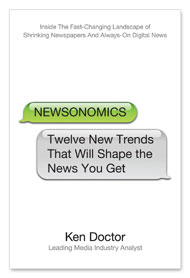
Ken Doctor's "Newsonomics: Twelve Laws That Will Shape the News We Get" is now available, with discount, for group purchases -- student or professional -- of 10 or more.